
For a long time, I thought fear was the thing holding me back.
Fear of being seen.
Fear of not being ready.
Fear of getting it wrong.
Fear of discovering that maybe I wasn't who I hoped I was.
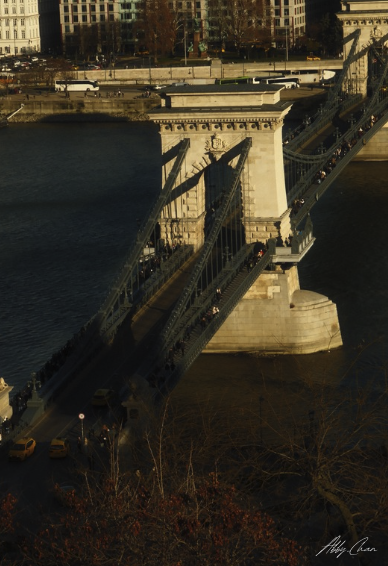
Chain Bridge, Budapest — where I learned that bridges exist to be crossed, not admired from a distance. December 2024.
But lately, I've realized something different. Fear wasn't the real barrier. Permission was.
The bridge between fear and doing was never confidence, clarity, or perfection. It was permission — giving myself the right to begin before everything looked polished, approved, and presentable.
Because for a long time, I wasn't just afraid. I was a perfectionist. The kind that plans everything. Refines everything. Edits, adjusts, and rethinks every detail.
From the outside, it looks like discipline or excellence. But underneath, perfectionism can be a form of protection. A quiet way of saying, "If it isn't perfect, it won't be seen. And if it isn't seen, it can't be judged. If it can't be judged, it can't be rejected. If it can't be rejected, it can't hurt you."
Perfectionism is a very elegant form of self-defense.
I used to worry constantly about how something would be perceived. Whether it was refined enough, strong enough, creative enough, or impressive enough to exist publicly. And so I would adjust, wait, revise, and prepare — again and again. But in doing that, I was also delaying myself.
Fear didn't erase my creativity. It delayed my expression. And perfectionism gave fear a very convincing disguise. It made hesitation look like responsibility. It made delay look like maturity. It made overthinking look like wisdom.
But deep down, I knew the truth. I wasn't waiting for excellence. I was waiting for safety. Because being seen is vulnerable. And creating something imperfect, then releasing it into the world, requires a kind of courage that perfectionism doesn't teach you.
Perfectionism teaches control. But creation requires surrender.
What changed for me wasn't the disappearance of fear. It was the decision to move with it still present. The insecurity didn't vanish overnight. The doubts didn't dissolve the moment I started creating. They were still there — quietly questioning, occasionally loud, sometimes convincing.
But something else grew alongside them: self-trust.
Every time I did something imperfectly and survived it, fear lost a little of its authority. Every time I showed up without total certainty, I gained a little more courage. Not because the fear disappeared, but because it stopped controlling the outcome.
Doing didn't eliminate fear. Doing shrank it.
And over time, that small, repeated permission — to try, to post, to speak, to create, to move — began to reshape my identity. I started to see that I wasn't shy. I was intentional. I wasn't uncreative. I was unexpressed. I wasn't unready. I was simply waiting for permission no one else could give me.
A plan without execution is a fantasy. But perfectionism can keep you living inside that fantasy for a very long time, convincing you that one more adjustment will make everything safe. One more revision will remove the risk.
But nothing removes the risk of being seen. And maybe it's not meant to.
Maybe growth always requires a little exposure. Maybe becoming always involves a little discomfort. Maybe courage is not the absence of fear, but the willingness to move with it beside you. I'm learning that fear doesn't have to disappear for you to begin. It just has to stop making the decisions.
“Permission is what allows that shift.
Permission to try.
Permission to be seen.
Permission to be unpolished.
Permission to grow in public.”
If fear has tried to rename you — telling you that you're not creative enough, bold enough, or ready enough — pause and question that voice. Ask whether it is truth, or simply protection that has overstayed its welcome.
You may not be lacking anything. You may just be unexpressed. Fear doesn't vanish when you begin. But with every step you take, it takes up less space. And eventually, what once felt terrifying becomes familiar. What once felt risky becomes natural. What once required permission becomes your way of being.
